
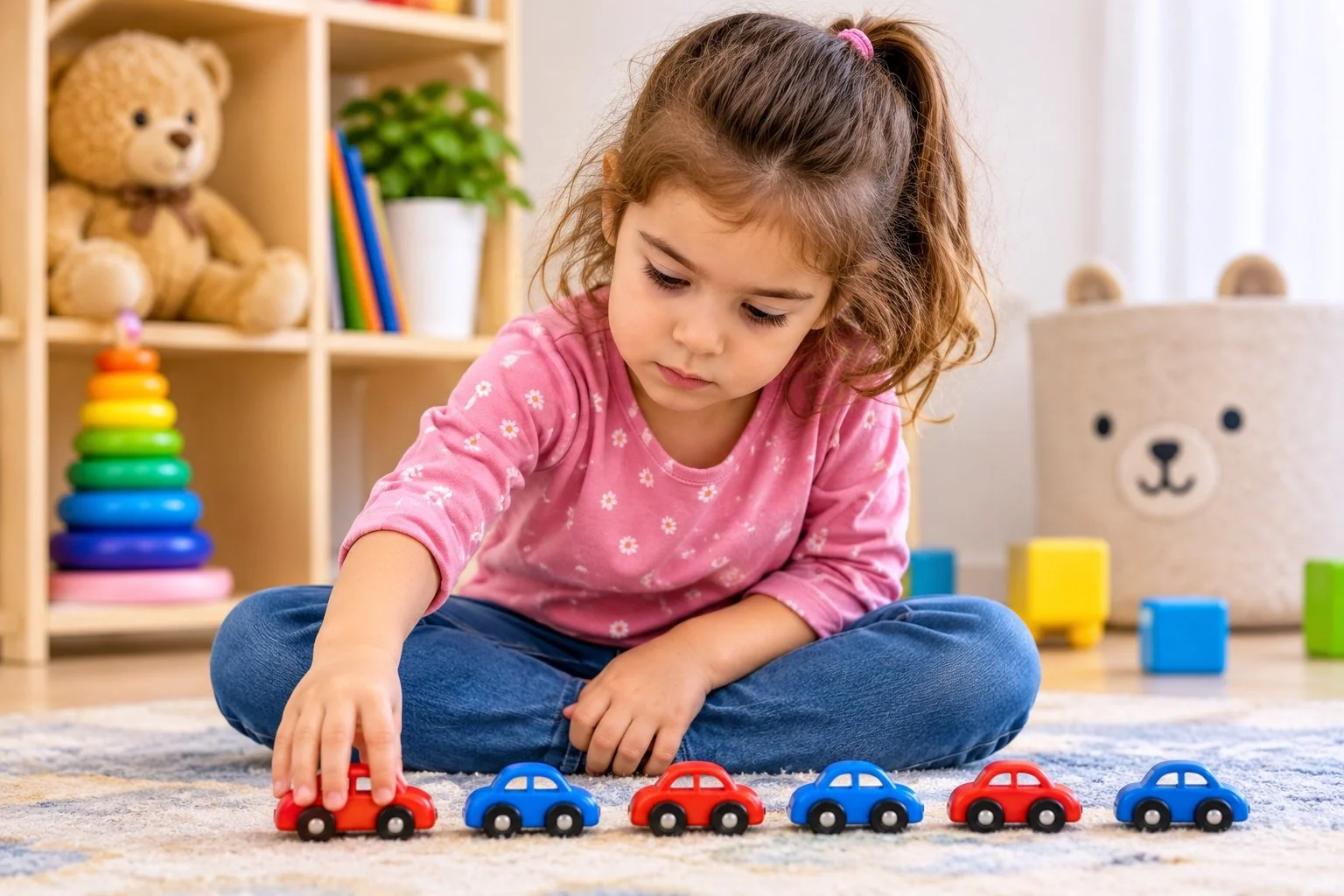
Your toddler has emptied the toy basket for the fourth time today. Yesterday, they spent half an hour lining up cars, and this morning, they wanted you to read the same book three times.
To an adult, it might look as though nothing new is happening.
But repetition is a normal part of how young children explore their surroundings. They often return to an activity because they're interested in what happens, want to try something differently or enjoy becoming familiar with a sequence.
Repetitive play in early childhood helps children explore cause and effect, practise movements, develop ideas and build familiarity with everyday experiences.
Understanding these patterns can help parents recognise learning that isn't immediately obvious.
What Is Repetitive Play in Early Childhood?
Repetitive play happens when children return to the same action, activity or sequence multiple times.
A child might repeatedly drop a ball, open and close a container, move blocks between baskets or pretend to cook the same meal.
Repetitive play happens when children return to the same action, activity or sequence multiple times.
A child might repeatedly drop a ball, open and close a container, move blocks between baskets or pretend to cook the same meal.
Sometimes the activity looks identical each time. At other times, a small detail changes.
For example, a toddler building a tower may initially use three blocks. After several attempts, they might experiment with larger blocks at the bottom or discover why a narrow tower keeps falling.
Research into young children's object play has identified repetition, variation and increasingly complex sequences as important features of early exploration.
For parents, the useful point is that familiar activities can still offer opportunities to learn.
Why Do Toddlers Repeat the Same Activities?
Young children don't always approach play with a particular outcome in mind.
They might be interested in the movement of an object, the sound it makes or what happens when they change something.
Repeating the experience allows them to explore those possibilities.
1. They're Learning How Things Work
Consider a child pouring water between two containers.
The first time, they might simply enjoy watching it move.
After several attempts, they may notice that a smaller container fills quickly or that water spills when they pour too fast.
This is an early opportunity to explore quantity, movement and cause and effect.
The child doesn't need a formal explanation of these concepts to begin investigating them.
2. Repetition Gives Them Opportunities to Practise
Many everyday skills develop through repeated attempts.
Think about learning to stack blocks, use a spoon, climb safely or complete a simple puzzle.
A child rarely masters a new action immediately.
They experiment, make adjustments and try again.
During play, these attempts happen naturally because the child is interested in the activity rather than working towards an adult-assigned task.
3. Familiar Activities Can Feel Reassuring
Children don't always want novelty.
Reading a favourite story or repeating a familiar game gives them an opportunity to anticipate what comes next.
They may remember when a character appears, recognise a repeated phrase or know how a game ends.
This familiarity can be particularly comforting during periods of change, such as starting childcare or adjusting to a new routine.
Repetition alone, however, doesn't tell us whether a child is seeking comfort or practising a skill. The surrounding situation matters.
What Are Play Schemas?
Some repeated patterns of play are described as play schemas.
A schema is a recurring pattern through which a child explores an idea or relationship.
The Froebel Trust's guidance on observing young children discusses how repeated movements and actions can help adults understand children's developing interests.
Here are several common examples.
Transporting: Moving Things From One Place to Another
Some children love filling bags, carrying toys across the room or moving objects between containers.
Rather than repeatedly telling them to put everything back, provide opportunities to transport suitable objects.
A basket of soft toys, a small trolley or containers in different parts of a play space can support this interest.
Rotation: Exploring Things That Turn
A child fascinated by spinning wheels, rotating objects or turning themselves around may be exploring movement.
You might offer toy vehicles, rolling balls or age-appropriate objects that rotate.
Safety and supervision remain important, especially around small parts and objects that could cause injury.
Enclosing: Creating Spaces and Boundaries
Some children enjoy building fences around toy animals, placing objects inside boxes or arranging blocks into enclosed shapes.
You can extend this interest using large blocks, cushions or simple construction materials.
The child may begin experimenting with how much space different objects need.
Trajectory: Watching How Things Move
Throwing, rolling, dropping and sliding objects can be ways of exploring movement.
A child who repeatedly pushes a toy car down a ramp may be interested in how its movement changes.
Offer safe alternatives such as rolling balls into a basket or sending toy vehicles down ramps.
The aim isn't to label every action. Play schemas are useful observations, not developmental diagnoses or fixed personality types.
Should Parents Interrupt Repetitive Play?
Not simply because an activity has been repeated.
If your child is engaged, safe and interested, there may be little reason to redirect them.
Adults sometimes feel pressure to introduce something new because the same activity appears too simple.
But changing activities frequently can interrupt a child's opportunity to investigate an idea.
Imagine a toddler repeatedly stacking blocks and knocking them down.
Instead of suggesting painting or puzzles straight away, watch what they're doing.
Are they experimenting with tower height? Do they prefer larger blocks? Are they inviting someone else to join?
Their actions may offer clues about what they're currently interested in exploring.
Naturally, some activities need to stop because of meals, rest, safety or other commitments.
When possible, give children a little warning before a transition.
How Can Educators Extend Repetitive Play?
In quality early childhood education, educators observe children's interests and use those observations to inform learning experiences.
The Australian Children's Education and Care Quality Authority (ACECQA) explains that play-based learning involves intentional teaching. Educators can support children's thinking through conversation, questions, modelling and carefully chosen resources.
For example:
A child who enjoys transporting objects might be offered baskets, buckets and different materials to move.
A child interested in building towers could explore wider blocks, different surfaces or collaborative construction.
A child repeatedly pretending to prepare food might develop their play through a pretend café, menus or opportunities to practise counting and communication.
These experiences extend existing interests without taking ownership of the activity away from the child.
Importantly, an educator doesn't need to turn every game into a formal lesson.
Sometimes careful observation and allowing uninterrupted exploration are the most appropriate responses.
How Repetitive Play Supports Language and Social Learning
Repetition isn't limited to physical actions.
Young children often repeat songs, stories, phrases and pretend conversations.
When an adult reads a familiar book, the child might begin remembering words, predicting events or joining in with repeated phrases.
Pretend play creates similar opportunities.
A child playing shopkeeper may repeatedly ask, "What would you like?" before handing over an imaginary item.
Through that familiar exchange, they can practise taking turns, using language and participating in social interactions.
As children develop, their play may become more detailed.
A pretend restaurant that initially involves serving one toy meal might eventually include customers, menus, payment and several children taking different roles.
These changes are examples of how familiar play can develop into more complex experiences.
Four Ways to Support Repetitive Play at Home
Parents don't need expensive educational toys or elaborate activities.
1. Keep Some Familiar Resources Available
Children may return to the same blocks, puzzles, toy vehicles or books over several days.
Rotating every toy too frequently can make it harder to revisit an activity.
2. Add One Small Change
If your child enjoys rolling balls, try a different-sized ball or a slightly longer ramp.
Let them decide whether they want to explore the change.
3. Describe What You Notice
Instead of continuously asking questions, make simple observations.
"You used the big block at the bottom."
"That ball rolled further."
This introduces language connected to what your child is doing without interrupting their concentration.
4. Let Children Lead Sometimes
Adults can support play without controlling every step.
Follow your child's interest, respond when invited and allow space for independent exploration when appropriate.
When Might Repetitive Behaviour Need Further Attention?
Repetitive play is common during early childhood and, by itself, isn't a reason for concern.
However, parents should consider the wider developmental picture.
Speak with a GP or child and family health nurse if repetitive behaviour occurs alongside concerns about communication, social interaction, development, loss of previously acquired skills or significant distress when routines change.
The purpose isn't to discourage repetition. It is to understand whether the child needs additional support.
Development varies considerably between children, and a professional assessment should consider more than one behaviour.
Encouraging Curiosity at Jane's Place ELC
At Jane's Place Early Learning Centre, children's individual interests play an important role in shaping learning experiences.
Our curriculum follows the Early Years Learning Framework, with opportunities for children to explore, communicate, build relationships and develop confidence through play.
Thoughtfully arranged indoor and outdoor spaces provide room for discovery, while educators support learning in ways that respect each child's interests and developmental needs.
Sometimes meaningful learning looks like a new discovery. Other times, it looks like a child building the same tower for the tenth time.
Both deserve attention.
Families looking for a nurturing, play-based early learning centre in Sydney can explore Jane's Place and learn more about our approach to early childhood education.
Frequently Asked Questions
Is repetitive play normal for toddlers?
Yes. Many toddlers repeatedly explore the same objects, movements and activities. Repetition can provide opportunities to practise skills and understand how things work.
What are examples of repetitive play?
Examples include stacking blocks, filling and emptying containers, rolling toy cars, repeating songs, reading favourite books and recreating the same pretend-play scenarios.
How does repetitive play support learning?
It gives children opportunities to investigate cause and effect, practise movements, notice patterns and explore new variations within familiar experiences.
Should I encourage my child to try different activities?
Variety is valuable, but children also benefit from time to explore their existing interests. Offer different experiences without forcing a change every time your child repeats an activity.